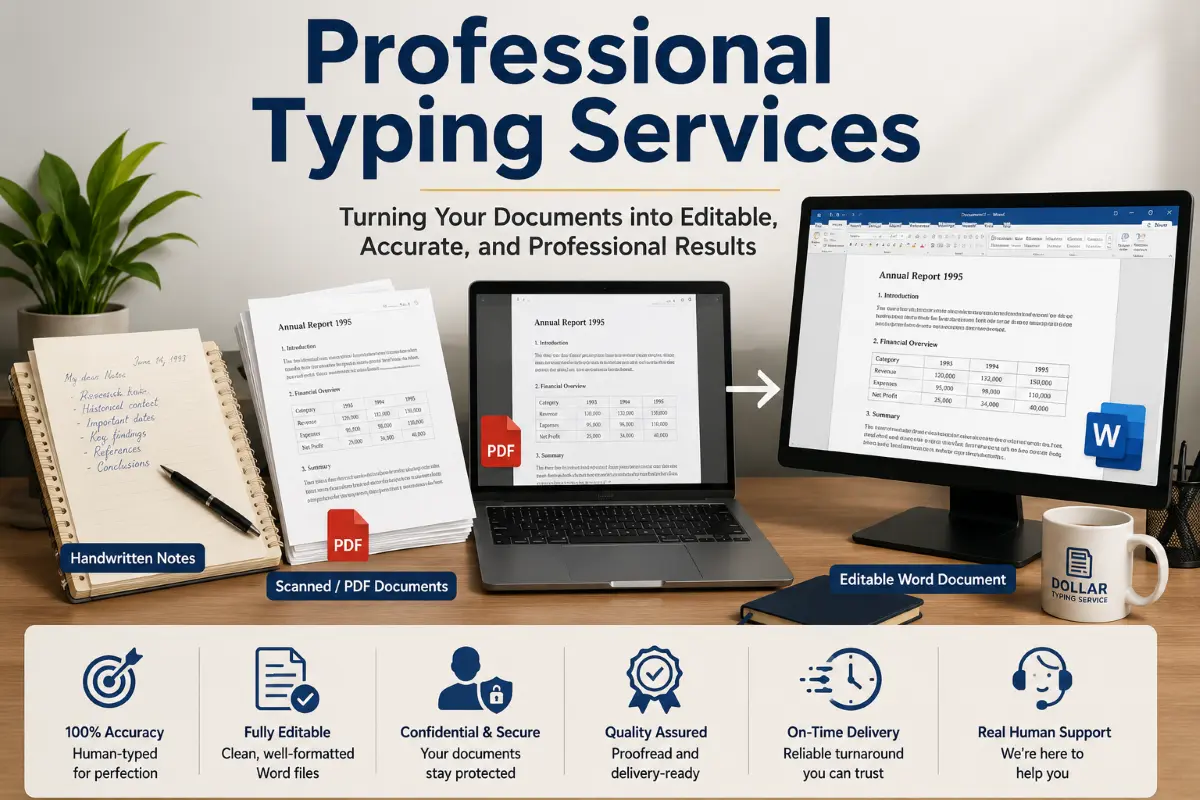
Living Guide: This article is regularly reviewed and updated to reflect current best practices in professional typing services, document conversion and OCR technologies.
In This Guide
This cornerstone guide explains everything you need to know about professional typing services—from manual document conversion and OCR limitations to document types, workflows, quality assurance, confidentiality, and choosing the right provider.
- Understand what a professional typing service actually does
- Learn when manual typing is better than OCR
- Discover which documents can be professionally typed
- See how professional typing projects are completed
- Compare human expertise with automated document conversion
- Learn how to choose a reliable typing service
Professional typing services convert handwritten, printed, scanned, PDF, and other non-editable documents into accurate, editable digital files through careful human typing, proofreading, formatting, and quality control. Unlike automated conversion software, experienced typists interpret each page to produce documents that are reliable, well-structured, and ready for editing, publishing, archiving, or everyday business use.
Although OCR (Optical Character Recognition) and AI-powered document recognition have made document conversion faster, they are not suitable for every project. Handwritten notes, poor-quality scans, historical records, complex tables, mathematical content, damaged pages, and unusual layouts often require the judgement and attention to detail that only human typists can provide.
Whether you're an author preserving handwritten manuscripts, a researcher digitizing field notes, a business converting paper archives, a student preparing a thesis, or an individual safeguarding family records, professional typing services remain one of the most dependable ways to create accurate, editable digital documents.
What You'll Learn
This comprehensive guide answers the most common questions about professional typing services, including:
- What a professional typing service is
- How professional document typing works
- Why manual typing still matters in the age of OCR and AI
- The different types of typing services available
- Which documents can be professionally typed
- Who uses professional typing services
- When manual typing is preferable to OCR
- How quality assurance and proofreading improve accuracy
- What to look for when choosing a typing service
This article serves as the cornerstone resource for the Professional Typing Services knowledge hub. As new educational resources are published, this guide will continue to grow, providing readers with a single, authoritative starting point for understanding professional document typing and manual document conversion.
What Is a Professional Typing Service?
A professional typing service is a specialized document conversion service in which trained human typists manually recreate information from physical or digital source documents into accurate, editable electronic files such as Microsoft Word documents.
Unlike automated document conversion software, professional typists read every page, interpret the information, and carefully reproduce the original content while maintaining readability, formatting, structure, and document consistency.
The objective is not simply to create an editable file. The goal is to produce a document that is accurate, professionally formatted, easy to edit, and ready for its intended purpose—whether that purpose is publishing, archiving, business use, academic work, legal reference, or long-term preservation.
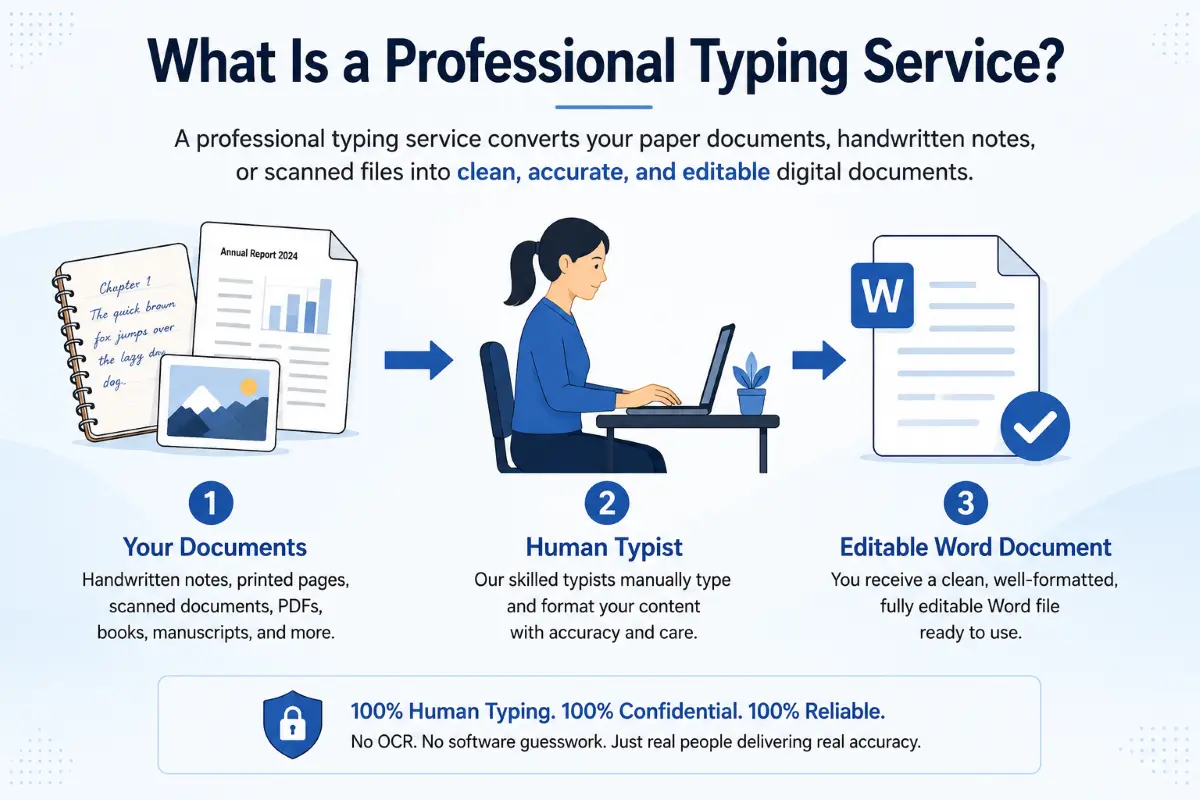
The Goal Is Accuracy—Not Just Editable Text
A professionally typed document should preserve both the content and the structure of the original while producing a clean, consistent file that requires little or no additional correction.
Professional Typists Do Much More Than Copy Text
Modern professional typing services combine several specialized tasks throughout the document conversion process. Every project typically involves careful interpretation, formatting, proofreading, and quality verification before the completed files are delivered to the client.
Manual Typing
Every page is read and manually typed by an experienced human typist rather than relying solely on automated OCR software.
Document Formatting
Headings, paragraphs, tables, lists, page numbering, spacing and document structure are recreated wherever practical.
Proofreading
Completed work is reviewed to identify typing errors, omissions, punctuation issues and formatting inconsistencies.
Quality Assurance
Final documents are compared against the original source to verify completeness and overall accuracy before delivery.
Documents Commonly Converted by Professional Typing Services
Professional document typing is suitable for almost any readable document. Common projects include:
- Handwritten notes
- Handwritten manuscripts
- Printed books
- Scanned images
- Image-based PDFs
- Business reports
- Research notebooks
- Academic theses
- Dissertations
- Historical records
- Meeting minutes
- Legal documents
- Medical records
- Forms
- Journals and diaries
- Letters and correspondence
- Technical documentation
- Archive collections
Why Professional Typing Services Still Matter
With OCR (Optical Character Recognition) software and AI-powered document recognition becoming increasingly capable, many people assume professional typing services are no longer necessary. While these technologies have transformed document digitization, they perform best when source documents are clean, clearly printed, properly scanned, and free from complex formatting or handwriting.
Real-world documents are rarely that simple. Businesses, researchers, authors, libraries, government agencies, and individuals often work with documents that contain faded text, handwritten notes, damaged pages, annotations, stamps, tables, unusual layouts, or poor-quality scans. These situations require interpretation, judgement, and experience—not simply character recognition.
Automation Works Best Under Ideal Conditions
OCR software can achieve impressive results when documents are created using modern fonts, printed clearly, scanned at high resolution, and contain straightforward layouts. Under those conditions, OCR can significantly reduce the amount of manual work required.
However, many document conversion projects involve material that falls well outside these ideal conditions.
Common Challenges for OCR
- Handwritten notes and cursive writing
- Historical documents with faded ink
- Old books with worn or damaged pages
- Low-resolution or blurred scans
- Photographs of documents taken with mobile phones
- Complex tables and multi-column layouts
- Annotations, stamps and handwritten corrections
- Mixed fonts and unusual page formatting
Human Judgement Makes the Difference
A professional typist does more than identify individual characters. Human typists understand context, recognise sentence structure, distinguish between similar-looking letters and numbers, preserve formatting, and make informed decisions whenever the original document is unclear.
For example, experienced typists can often determine whether a character is the letter "O" or the number "0", whether a handwritten word has been misspelled intentionally, or how a damaged table should be recreated for readability. These are decisions that frequently require human interpretation rather than automated recognition.
Why Accuracy Matters
For legal records, academic research, business documentation, historical archives, medical information, and publication-ready manuscripts, even small transcription errors can create significant problems. Producing an accurate document from the beginning is often more efficient than correcting hundreds of OCR mistakes later.
Professional Typing Saves Time in the Long Run
Although OCR may initially appear faster, documents with numerous recognition errors often require extensive manual correction. Reviewing, editing, and reformatting inaccurate OCR output can take longer than having the document professionally typed from the outset.
Professional typing services are therefore especially valuable when accuracy, readability, formatting consistency, and dependable results are more important than simply obtaining an editable file.
What Does a Professional Typing Service Do?
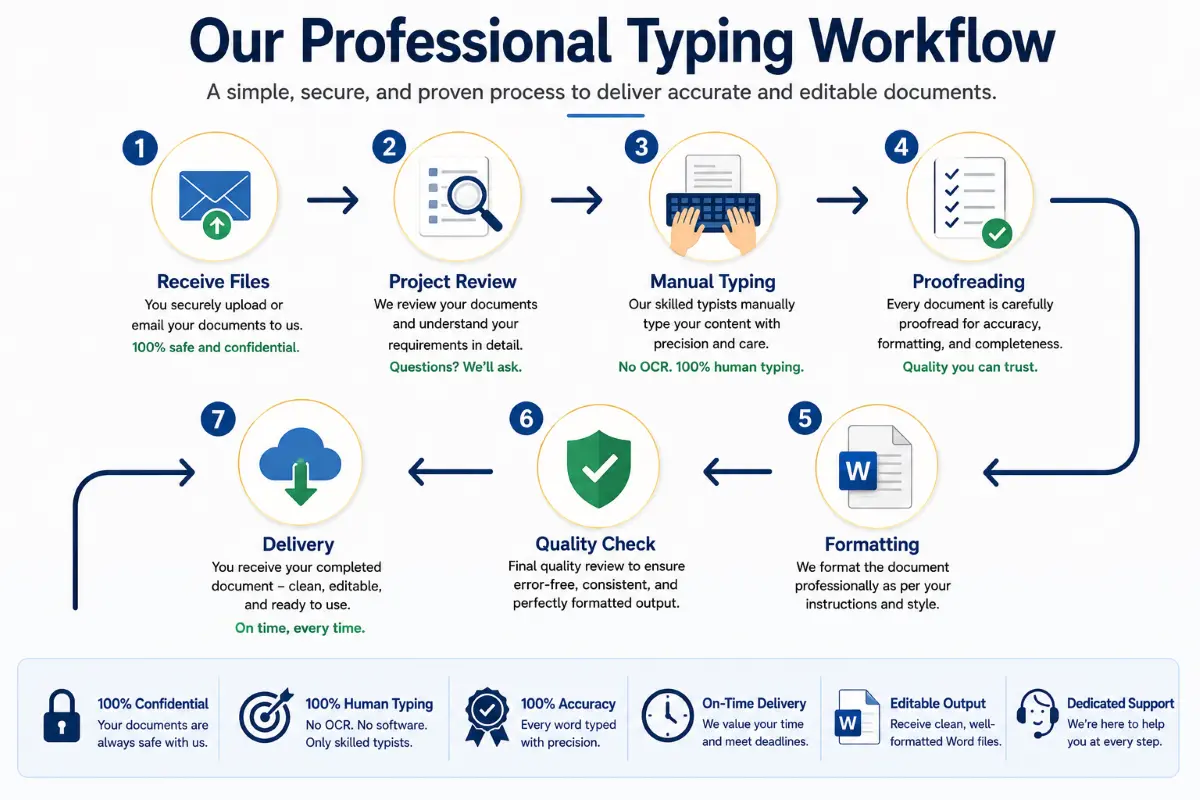
A professional typing service involves much more than simply copying text from one document into another. Every project combines document interpretation, manual typing, formatting, proofreading, and quality assurance to produce a final document that is accurate, editable, and ready for practical use.
Whether the source material consists of handwritten notes, scanned documents, printed books, PDFs, business reports, or historical records, experienced typists carefully recreate the content while preserving the original meaning, document structure, and formatting wherever practical.
Manual Document Typing
Every project begins with careful manual transcription. Instead of relying entirely on OCR software, a professional typist reads each page and manually recreates the document in an editable format.
This approach allows the typist to correctly interpret handwriting, distinguish between similar-looking characters, recognise formatting patterns, and resolve many of the ambiguities that automated software often struggles to handle.
Handwritten Documents
Notes, journals, diaries, letters, manuscripts and historical records are carefully interpreted and manually typed into editable documents.
Printed Material
Printed books, reports, manuals and archived documents are recreated while preserving headings, paragraphs and overall document structure.
Scanned Files
Low-quality scans, photographs and image-based PDFs can often be converted successfully through careful human interpretation.
Complex Documents
Tables, forms, multi-column layouts, footnotes and specialised formatting are recreated with attention to detail.
Professional Formatting
Producing editable text is only one part of the job. Professional formatting ensures that the finished document is organised, consistent, and easy to edit in the future.
Depending on the project, formatting may include:
- Heading hierarchy
- Paragraph formatting
- Fonts and font styles
- Line spacing
- Margins
- Page numbering
- Tables
- Bullet and numbered lists
- Footnotes
- References
- Section breaks
- Table of contents preparation
Formatting Improves More Than Appearance
Well-formatted documents are easier to read, edit, publish, print, archive and share. Proper structure also reduces the amount of editing required after the typing project has been completed.
Proofreading and Quality Control
Every professionally typed document should undergo careful proofreading before delivery. This stage verifies that the typed version accurately reflects the original source material while correcting any typing or formatting inconsistencies discovered during review.
Typical quality checks include:
- Correcting typing mistakes
- Checking punctuation and capitalization
- Verifying page completeness
- Confirming paragraph consistency
- Reviewing tables and lists
- Comparing the finished document against the original source
Professional Typing Is a Complete Document Conversion Service
Rather than simply entering text with a keyboard, professional typing combines human interpretation, formatting expertise, proofreading, and quality assurance to deliver documents that are accurate, editable, and ready for immediate use.
Types of Professional Typing Services
Professional typing services cover a wide range of document conversion requirements. Although the underlying process always involves careful human typing and quality assurance, the techniques, formatting requirements, and level of interpretation vary depending on the type of document being converted.
Understanding these different services can help you choose the most appropriate solution for your project and ensure that your documents are converted accurately into editable digital files.
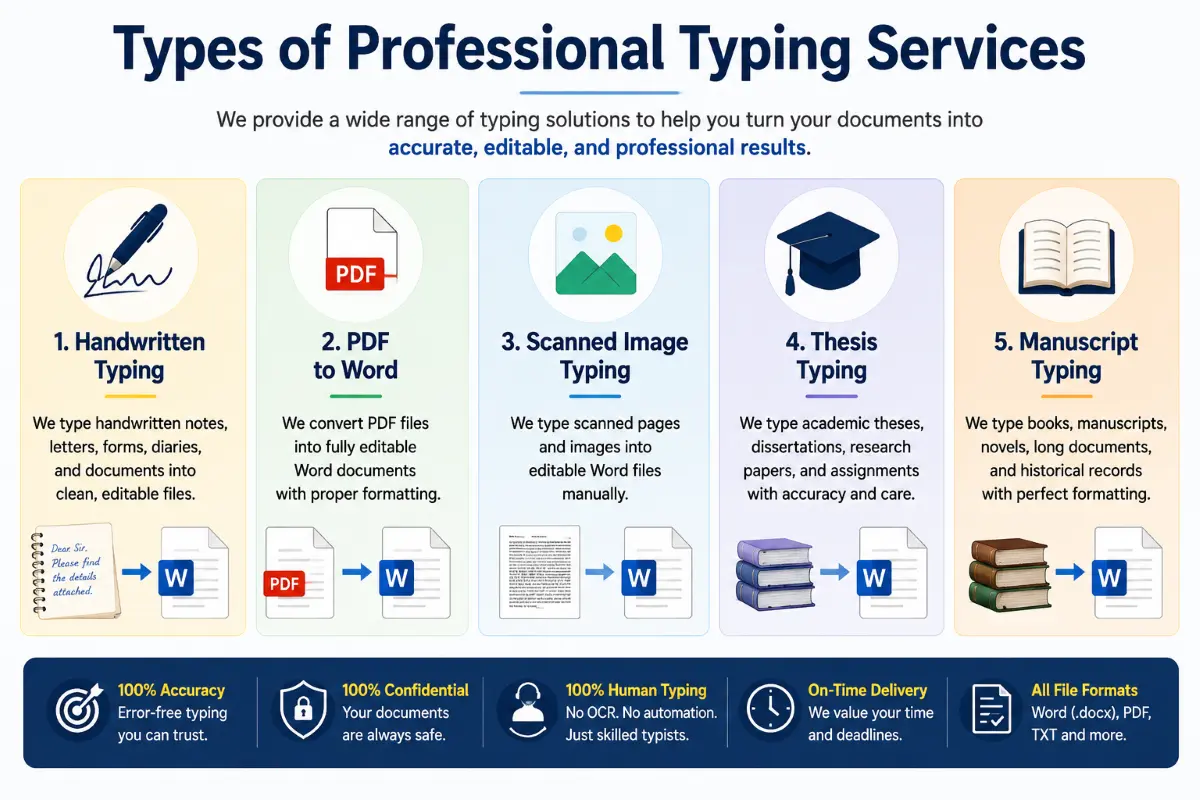
| Service | Typical Documents | Primary Objective |
|---|---|---|
| Handwritten Typing | Notes, diaries, journals, letters, manuscripts | Create accurate editable documents from handwriting |
| PDF to Word Typing | Scanned PDFs, reports, books, manuals | Produce editable Word documents while preserving layout |
| Scanned Image Typing | JPG, PNG, TIFF, photographed documents | Convert images into editable text |
| Academic Typing | Theses, dissertations, research papers | Maintain formatting, citations and academic structure |
| Book & Manuscript Typing | Books, memoirs, novels, historical works | Create publication-ready editable manuscripts |
Handwritten Document Typing
Handwritten typing services convert handwritten documents into editable digital files while preserving the original wording and document structure. Projects commonly include notebooks, family letters, historical records, medical notes, research journals, personal diaries, and handwritten manuscripts.
Because handwriting styles vary considerably from one writer to another, this type of work depends heavily on human interpretation rather than automated recognition software.
Ideal For
- Handwritten notes
- Old journals and diaries
- Family letters
- Historical manuscripts
- Research notebooks
PDF to Word Typing
PDF typing services recreate both printed and scanned PDF documents as fully editable Microsoft Word files. This is particularly useful when PDFs contain complex layouts, tables, forms, or scanned pages that cannot be edited directly.
Manual typing often provides significantly better results than automated PDF conversion when document quality is poor or formatting must be preserved accurately.
Ideal For
- Business reports
- Government forms
- Books
- Multi-column documents
- Technical manuals
Scanned Image Typing
Many important documents exist only as scanned images or photographs. These files may be stored as JPG, PNG, TIFF, or image-based PDF files, making them difficult—or sometimes impossible—to edit directly.
A professional scanned image typing service manually converts these image files into editable documents while preserving the original content, layout, headings, tables, and document structure as closely as possible.
Human typing is especially valuable when scanned images suffer from poor contrast, faded printing, skewed pages, shadows, background stains, or low resolution—situations where OCR software frequently produces inaccurate results.
Ideal For
- Scanned contracts
- Image-based PDF files
- Old newspaper articles
- Historical archive scans
- Photographed documents
- Poor-quality scanned records
Academic Thesis and Dissertation Typing
Academic documents often require considerably more than accurate text entry. Universities typically specify detailed formatting rules for margins, headings, references, pagination, tables, figures, footnotes, and citation styles.
Professional thesis typing services help students, researchers, and academic institutions prepare editable documents that follow these formatting requirements while maintaining a consistent, professional appearance.
Depending on the project, this may include formatting references, bibliographies, equations, tables, appendices, and section numbering in addition to manual typing.
Ideal For
- University theses
- Dissertations
- Research papers
- Academic reports
- Conference papers
- Research documentation
Book and Manuscript Typing
Authors, historians, publishers, and families frequently need printed books or handwritten manuscripts converted into editable digital documents. These projects often involve hundreds of pages and require careful attention to consistency across the entire document.
Professional manuscript typing focuses on producing clean, editable files that can be reviewed, edited, published, archived, or preserved for future generations.
Long-form projects frequently include chapter headings, footnotes, illustrations, indexes, tables of contents, and specialised formatting, making careful human review an essential part of the workflow.
Ideal For
- Books
- Memoirs
- Novels
- Historical manuscripts
- Personal journals
- Archive preservation projects
Choosing the Right Service Matters
Every document presents unique challenges. Selecting the appropriate professional typing service ensures that the workflow, quality checks, formatting standards, and final deliverables match the needs of your specific project instead of relying on a one-size-fits-all approach.
Documents That Can Be Professionally Typed
One of the biggest misconceptions about professional typing services is that they are limited to handwritten notes or printed pages. In reality, almost any readable document can be converted into an accurate, editable digital file through careful manual typing.
Every project is different. Some involve a few pages of handwritten notes, while others consist of thousands of pages of business records, historical archives, technical manuals, or research material. The common objective remains the same: to create a reliable digital document that faithfully represents the original source.
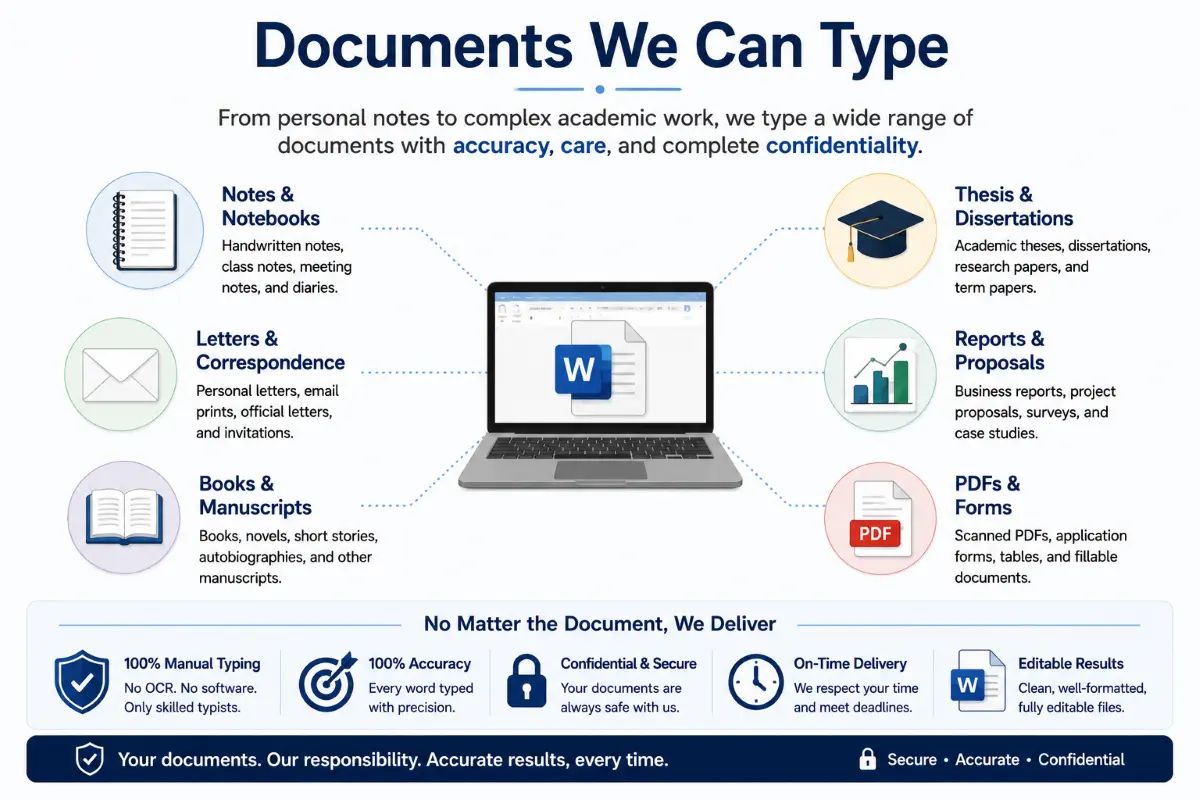
Personal Documents
Individuals frequently use professional typing services to preserve valuable personal documents that exist only on paper. Digitising these records helps protect them from deterioration while making them easier to search, edit, organise and share.
- Personal diaries
- Family journals
- Letters and correspondence
- Recipe collections
- Memoirs
- Travel journals
- Genealogy records
- Personal notebooks
Business Documents
Businesses often need paper-based information converted into editable digital files for operational efficiency, record management and future editing. Professional typing services help organisations modernise their document workflows without losing valuable historical information.
- Business reports
- Meeting minutes
- Policy manuals
- Employee records
- Standard operating procedures
- Technical documentation
- Training materials
- Corporate archives
Academic and Research Documents
Students, researchers and educational institutions frequently require high levels of accuracy, particularly when documents contain references, citations, tables, equations and specialised formatting.
- Theses
- Dissertations
- Research papers
- Laboratory notebooks
- Field notes
- Lecture notes
- Reference material
- Academic manuscripts
Publishing and Creative Projects
Authors and publishers often work with handwritten drafts, printed manuscripts and historical material that must be converted into editable files before editing, proofreading or publication can begin.
- Books
- Novels
- Memoirs
- Historical manuscripts
- Author drafts
- Publishing archives
- Magazine articles
- Editorial material
Every Readable Document Has Digital Potential
Whether your documents are handwritten, printed, scanned or stored as image-based PDFs, professional manual typing can transform them into editable digital files that are easier to search, revise, preserve and share.
Who Uses Professional Typing Services?
Professional typing services support a remarkably diverse range of clients. While many people associate document typing with authors or students, the reality is that organizations and individuals from almost every profession occasionally need paper documents converted into accurate, editable digital files.
Some clients require a few handwritten pages converted into Microsoft Word, while others need thousands of archived documents digitized over several months. Regardless of project size, the objective remains the same: produce an accurate, professionally formatted document that can be searched, edited, shared, and preserved for years to come.
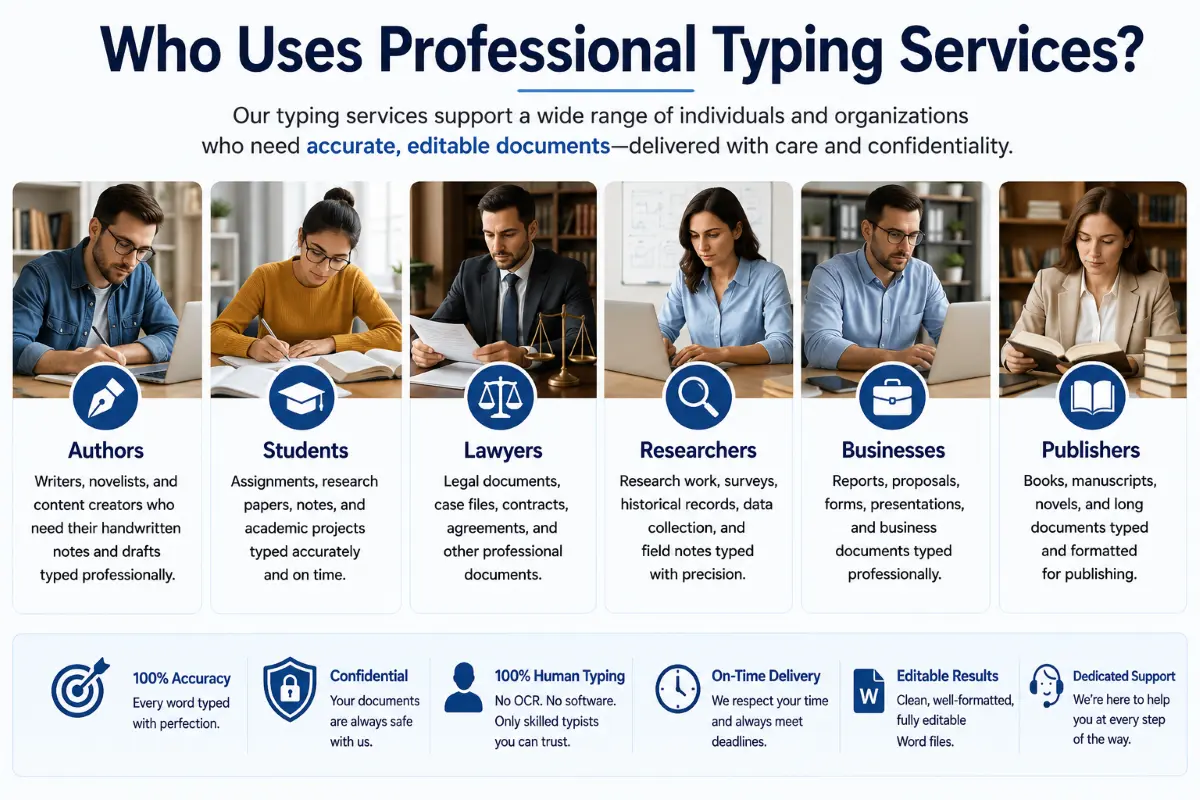
Authors and Publishers
Authors often have handwritten manuscripts, notebooks, research material or older printed drafts that must be converted into editable documents before editing and publication can begin. Publishers also use professional typing services to digitize older publications that are no longer available in editable formats.
Students and Researchers
Universities and research organizations regularly work with handwritten notes, field journals, laboratory notebooks, interview transcripts and academic papers. Converting these documents into searchable digital files improves collaboration, editing and long-term preservation.
Businesses and Corporate Offices
Businesses continue to maintain large collections of contracts, operational manuals, historical reports, meeting minutes and paper records. Professional typing services help modernize these archives by transforming paper documents into editable files that integrate easily into modern digital workflows.
Corporate Records
Policies, reports, meeting minutes, operational manuals and archived documentation.
Educational Institutions
Lecture notes, examination material, research documentation, theses and dissertations.
Publishing Industry
Books, manuscripts, memoirs, editorial drafts and historical publications.
Private Individuals
Family records, journals, personal letters, recipes and historical collections preserved for future generations.
Legal and Medical Professionals
Law firms, legal consultants and healthcare organizations frequently manage documents where precision is essential. Historical case files, legal records, patient documentation and handwritten notes often require careful manual typing because even minor transcription errors may have significant consequences.
Libraries, Museums and Archives
Cultural institutions preserve valuable historical collections that often exist only as fragile handwritten or printed documents. Professional typing allows these materials to become searchable and accessible while reducing the need to repeatedly handle delicate originals.
Professional Typing Is About Preserving Knowledge
Whether the document contains business information, academic research, family history or creative work, professional typing helps preserve valuable information in a format that remains useful, searchable and editable long into the future.
Professional Typing Services vs OCR
One of the most common questions people ask before starting a document conversion project is whether they should use OCR (Optical Character Recognition) software or hire a professional typing service. The answer depends largely on the quality of the original documents and the level of accuracy required.
OCR technology has improved considerably over the past decade and works well with many modern printed documents. However, even the best OCR systems can struggle with handwritten material, poor-quality scans, unusual page layouts, faded text, annotations, tables, and historical documents.
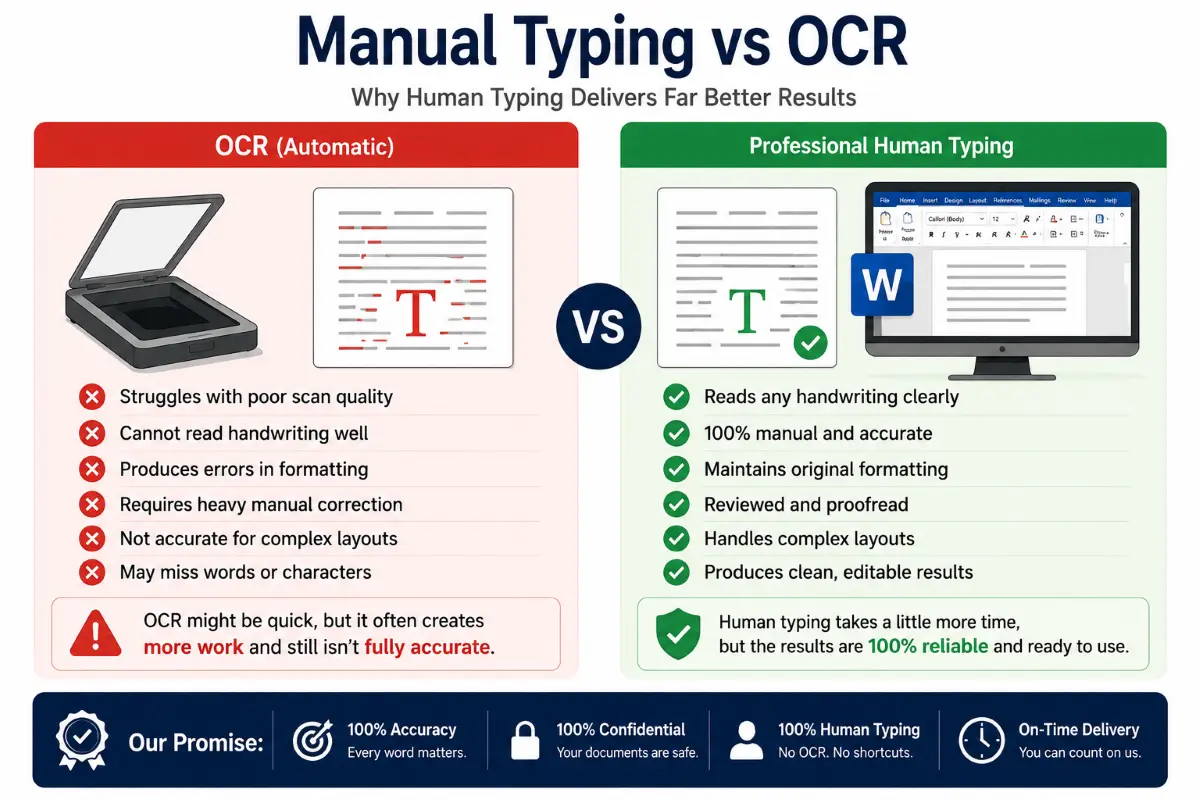
| Feature | OCR Software | Professional Typing Service |
|---|---|---|
| Printed Documents | Excellent for clean originals | Excellent |
| Handwritten Documents | Often unreliable | Excellent |
| Poor Quality Scans | Frequently produces errors | Human interpretation improves accuracy |
| Complex Layouts | Formatting may be lost | Formatting is manually recreated |
| Proofreading | Not included | Included as part of quality control |
| Accuracy | Depends on document quality | Consistently high with human review |
| Ready for Publishing | Usually requires editing | Typically requires minimal correction |
When OCR Is the Right Choice
OCR is an efficient solution when documents are already well prepared. If the pages are clean, clearly printed, scanned at a high resolution, and contain straightforward layouts, OCR can produce satisfactory results while saving time.
- Modern printed documents
- High-resolution scans
- Simple page layouts
- Large collections requiring basic text extraction
When Professional Typing Is the Better Option
Human typing becomes the preferred solution whenever document quality, formatting, readability or accuracy cannot be left entirely to software. Experienced typists recognise context, interpret unclear characters, preserve formatting and verify the finished document before delivery.
- Handwritten notes and manuscripts
- Historical documents
- Old books and archive material
- Poor-quality scans and photographs
- Tables, forms and multi-column layouts
- Legal, medical and academic documents
- Publication-ready manuscripts
The Best Solution Often Combines Both
Many professional typing projects begin with OCR to extract available text, followed by careful human correction, proofreading and formatting. This hybrid approach combines the speed of automation with the accuracy and judgement of experienced typists.
Benefits of Professional Typing Services
Professional typing services offer far more than simply converting paper documents into editable text. They provide accuracy, consistency, document preservation, and significant time savings while ensuring that valuable information remains usable for years to come.
Whether the project involves a single handwritten letter or thousands of archived documents, the objective is always the same—deliver an accurate, professionally formatted document that can be edited, searched, shared, and preserved with confidence.
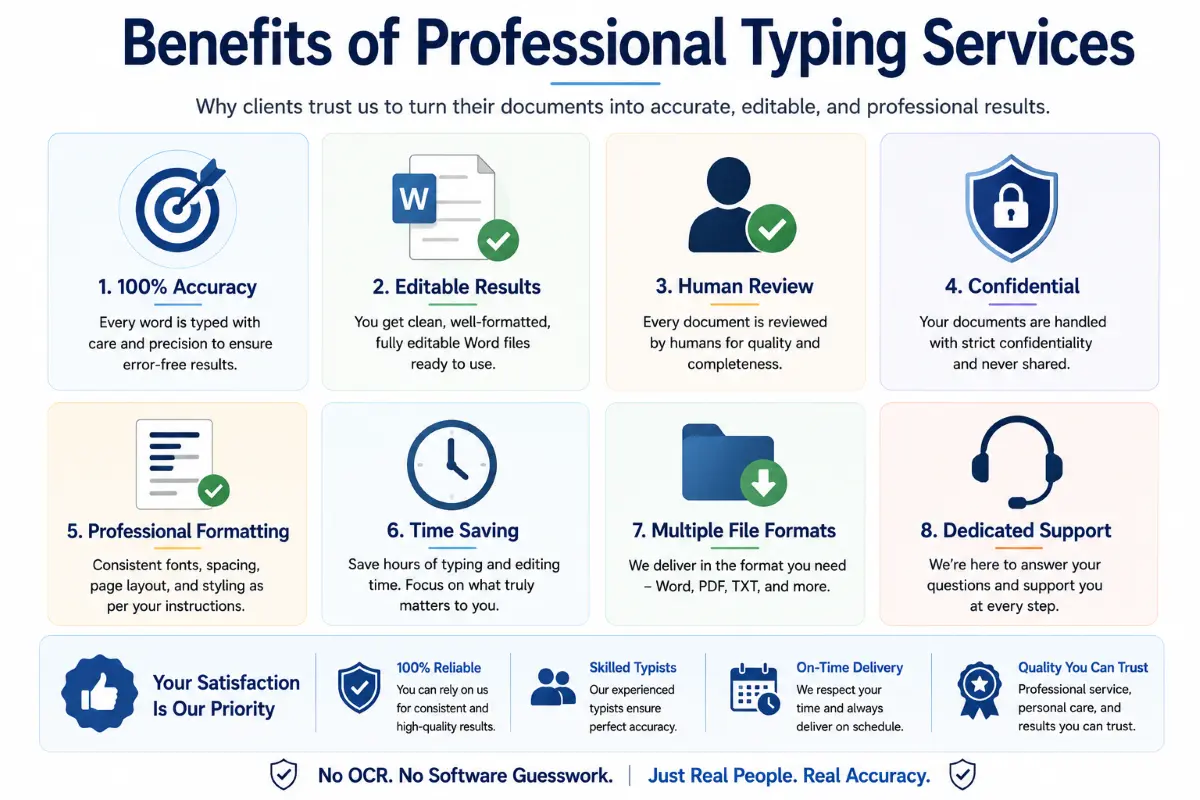
Exceptional Accuracy
Human typists interpret context, recognise handwriting, understand document structure and identify potential errors that automated software frequently misses. This produces documents with a much higher level of accuracy, particularly for complex source material.
Fully Editable Documents
The finished files can be updated, reformatted, searched, printed and shared without the restrictions associated with scanned images or locked PDF documents.
Professional Formatting
Headings, tables, page numbers, lists, spacing and document layout are recreated to produce files that are organised, consistent and easy to work with.
Human Quality Control
Proofreading and document comparison help identify omissions, formatting inconsistencies and typing mistakes before the files are delivered to the client.
Time Savings
Correcting inaccurate OCR output can take many hours. Professional typing often reduces the overall project time by producing a cleaner document from the beginning.
Long-Term Preservation
Converting paper documents into editable digital files protects valuable information from deterioration while making future storage, searching and backup much easier.
Why Accuracy Is So Important
The value of a professionally typed document depends on its reliability. Even small transcription errors can affect legal records, academic research, business reports, medical documentation and historical archives. Professional typing services reduce this risk through careful manual transcription followed by systematic proofreading and quality verification.
Accuracy Is an Investment
Spending additional time producing an accurate document today often saves many hours of editing, correction and verification later. For important documents, accuracy is not simply a convenience—it is a necessity.
Supporting Better Document Management
Editable documents integrate easily with modern document management systems, cloud storage platforms, collaboration tools and backup solutions. Instead of relying on paper files or image-only documents, organizations can search, organise and update information efficiently.
- Easy keyword searching
- Simple document editing
- Digital archiving
- Cloud storage compatibility
- Improved collaboration
- Reduced physical storage
- Simplified version control
- Better long-term accessibility
How a Professional Typing Service Works
Although every project is unique, most professional typing services follow a structured workflow designed to deliver accurate, consistent and high-quality results. Each stage builds upon the previous one, reducing the possibility of errors while ensuring that the final document meets the client's requirements.
A clearly defined workflow is one of the key differences between a professional typing service and simple text entry. Rather than typing documents as quickly as possible, experienced providers combine planning, manual transcription, proofreading and quality assurance into a repeatable process that produces dependable results.
-
1. Document Review
The project begins with an assessment of the source material. The typist reviews document quality, handwriting legibility, formatting complexity, page count and any special instructions before work begins.
-
2. Project Planning
Appropriate formatting standards, turnaround expectations, delivery format and any project-specific requirements are established before typing starts. Early planning reduces delays and helps maintain consistency throughout larger projects.
-
3. Manual Typing
Each page is carefully transcribed into an editable document. Human typists interpret handwriting, preserve formatting where appropriate and recreate the original content as accurately as possible.
-
4. Formatting
Headings, paragraphs, tables, lists, page numbers and other structural elements are organised into a professional document that is easy to edit, read and print.
-
5. Proofreading
The completed document is carefully reviewed to identify typing mistakes, missing text, punctuation errors and formatting inconsistencies before final delivery.
-
6. Quality Assurance
A final comparison against the original source document helps verify completeness, consistency and overall accuracy.
-
7. Delivery
The finished document is delivered in the agreed editable format, typically Microsoft Word, ready for editing, collaboration, publication or archiving.
Every Stage Protects Document Quality
Skipping proofreading or quality assurance may save time initially, but it often results in costly corrections later. A structured workflow ensures that every document receives the attention needed to achieve a consistently high standard of accuracy.
Professional Workflows Scale to Any Project Size
Whether the assignment involves five pages or five thousand, the same principles apply. Breaking work into clearly defined stages allows large document collections to be completed efficiently without sacrificing quality or consistency.
This disciplined approach is one of the reasons professional typing services continue to be trusted for business records, academic research, publishing projects, historical archives and other documents where accuracy matters.
Typical Deliverables
- Editable Microsoft Word documents
- Accurately typed text
- Consistent document formatting
- Proofread content
- Clearly organised page structure
- Files ready for editing, printing or publication
Accuracy, Proofreading and Quality Assurance
Accuracy is the foundation of every professional typing service. Producing an editable document has little value if the finished file contains transcription errors, missing information or formatting inconsistencies. For this reason, experienced typing professionals treat quality assurance as an essential part of the document conversion process rather than an optional final step.
Whether the project involves handwritten manuscripts, historical archives, academic research or business documentation, every document should be reviewed carefully before delivery to ensure that it faithfully represents the original source.
Why Accuracy Matters
Even seemingly minor typing errors can have significant consequences. Incorrect dates, names, figures or technical terminology may require extensive corrections later or, in some situations, lead to costly misunderstandings.
Professional typing services are therefore particularly valuable for documents where precision is essential, including legal records, academic papers, business reports, historical documents and publication manuscripts.
Legal Documents
Contracts, agreements and case records require precise transcription because even small errors may alter the intended meaning of the document.
Academic Research
Research papers, theses and dissertations depend on accurate references, citations, tables and technical terminology.
Business Records
Reports, procedures and operational documentation must remain reliable because they often support everyday business decisions.
Historical Archives
Preserving historical documents requires careful interpretation so that valuable information is accurately transferred into digital form.
The Importance of Proofreading
Proofreading is far more than a quick spelling check. It is a systematic review of the completed document to verify that the typed version matches the original source while maintaining consistent formatting, punctuation and document structure.
During proofreading, professional typists typically verify:
- Typing accuracy
- Spelling consistency
- Punctuation
- Paragraph structure
- Page completeness
- Heading hierarchy
- Tables and lists
- Formatting consistency
- Special characters
- Numbers and dates
Proofreading Protects the Entire Project
Detecting a single missing paragraph, incorrect number or misplaced heading before delivery can save hours of revision later. Careful proofreading is one of the defining characteristics of a professional typing service.
Quality Assurance Is a Continuous Process
Rather than waiting until the end of the project, experienced typists continuously review their work throughout the typing process. This reduces the likelihood of repeated errors and helps maintain consistency across large multi-page documents.
Many professional workflows also include a final comparison against the original document before delivery. This additional verification step helps confirm that no pages have been omitted and that formatting has been applied consistently throughout the completed file.
Characteristics of a High-Quality Typed Document
- Accurately reflects the original source
- Complete with no missing content
- Consistent formatting throughout
- Professionally proofread
- Easy to edit and search
- Ready for publication, archiving or everyday use
Security and Confidentiality
Many documents submitted to professional typing services contain confidential, personal or commercially sensitive information. Business reports, legal records, medical documentation, unpublished manuscripts, academic research and personal correspondence all require careful handling throughout the document conversion process.
Choosing a professional typing service is therefore not only about accuracy—it is also about trust. Clients should feel confident that their documents will be handled responsibly, accessed only when necessary, and returned securely after the work has been completed.
Types of Confidential Documents
Professional typists regularly work with documents that contain sensitive information and deserve appropriate protection.
Business Documents
Internal reports, operating procedures, financial records, contracts, proposals and confidential correspondence.
Legal Documents
Court records, legal agreements, witness statements, evidence files and case documentation requiring precise handling.
Academic Research
Research notes, unpublished studies, dissertations and manuscripts prepared for future publication.
Personal Records
Diaries, journals, family histories, letters, memoirs and private documents preserved for future generations.
Good Security Practices
A professional typing service should have clear procedures for handling client documents from the moment they are received until the completed files are delivered. While specific procedures may vary between providers, responsible document handling generally includes:
- Receiving files through secure upload methods
- Limiting document access to authorized personnel
- Protecting client privacy throughout the project
- Maintaining organized project management procedures
- Delivering completed files securely
- Removing client files when they are no longer required, if agreed
Trust Is Earned Through Professional Practices
Confidentiality is not a feature that can be added at the end of a project. It should be part of every stage of the workflow, from receiving the original documents to delivering the final editable files.
Questions Worth Asking Before Hiring
If your documents contain confidential or commercially valuable information, it is reasonable to ask prospective providers about their document handling procedures before placing an order.
- How are uploaded documents stored?
- Who has access to my files?
- Can confidential projects be accommodated?
- Will completed files be returned through secure delivery methods?
- What happens to my files after the project is completed?
Balancing Accessibility and Privacy
The purpose of document digitization is to make information easier to access and use—not to compromise its confidentiality. A well-managed professional typing service balances convenience with responsible document handling, allowing clients to benefit from editable digital files while maintaining appropriate privacy throughout the project.
Why Confidentiality Matters
Trust is one of the defining characteristics of a professional typing service. Clients are often sharing documents that cannot be replaced, making responsible handling every bit as important as typing accuracy and document quality.
Choosing the Right Professional Typing Service
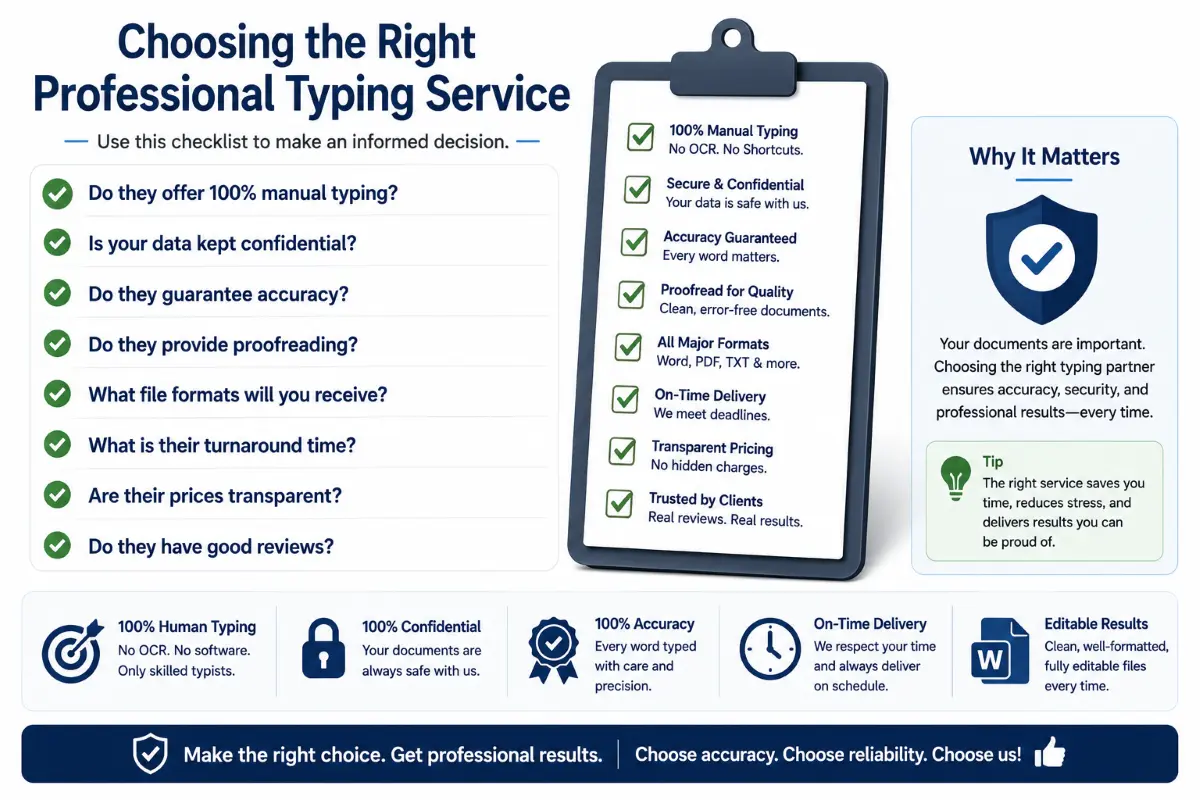
Not all professional typing services provide the same level of quality, accuracy or expertise. While many providers can produce editable documents, the difference often lies in how carefully they interpret source material, preserve formatting, verify accuracy and communicate throughout the project.
Selecting the right provider should involve more than simply comparing prices. An experienced typing service can save significant time by delivering documents that require little additional correction, whereas poor-quality work may require extensive editing before it can be used.
Look Beyond Price
Competitive pricing is important, but it should not be the only deciding factor. A lower-priced service may become more expensive if the finished document requires extensive proofreading, formatting corrections or even complete retyping.
Value Comes From Quality
A professionally typed document that is accurate, consistently formatted and ready to use often represents better value than a cheaper document requiring hours of additional editing.
Questions to Ask Before Hiring
Asking a few practical questions before placing an order can help you determine whether a typing service is suitable for your project.
- Do they manually type documents instead of relying solely on OCR?
- Do they proofread completed work before delivery?
- Can they preserve complex formatting and document structure?
- Do they have experience with your type of document?
- How are confidential files handled?
- What editable formats will be delivered?
- Can they manage large multi-page projects?
- Do they communicate clearly throughout the project?
Experience Matters
Different document types present different challenges. Converting a clean printed report is very different from interpreting handwritten research notes, recreating complex tables, or preparing a publication-ready manuscript. Experience with similar projects often leads to better accuracy and fewer revisions.
Accuracy
Look for providers who emphasise careful manual typing, proofreading and quality assurance rather than speed alone.
Formatting Skills
Professional formatting ensures that documents remain easy to edit, print and publish after conversion.
Communication
Responsive communication helps clarify instructions, resolve uncertainties and avoid misunderstandings during the project.
Reliability
Consistent delivery, transparent processes and attention to detail are strong indicators of a dependable typing service.
Choose a Service That Matches Your Project
The best provider for a handwritten family diary may not necessarily be the best choice for a technical manual or an academic dissertation. Selecting a typing service with experience relevant to your specific document type helps ensure that the finished files meet your expectations.
A Good Typing Service Solves Problems
The right provider does more than convert text into an editable document. They help preserve information, improve document quality, reduce editing time and deliver files that are ready for practical use.
Common Mistakes to Avoid
Successful document conversion depends not only on choosing a professional typing service but also on preparing your documents properly and setting realistic expectations. Many of the problems people experience during document conversion are entirely avoidable with a little planning before the project begins.
Whether you are submitting handwritten notes, scanned images, printed books or PDF files, avoiding the following common mistakes can improve both the accuracy of the finished document and the overall efficiency of the project.
1. Assuming OCR Can Handle Every Document
OCR technology is extremely useful, but it is not designed for every situation. Handwritten documents, faded printing, poor-quality scans, damaged pages and complex layouts often require human interpretation. Attempting to rely entirely on OCR for these documents frequently results in extensive correction work later.
Don't Judge Success by Whether the File Is Editable
An editable document is only valuable if the content is accurate. Always review the quality of the converted text rather than assuming that editable automatically means correct.
2. Submitting Poor-Quality Source Documents
Even experienced typists work more efficiently when the original material is clear and readable. Cropped pages, blurred photographs, heavy shadows, skewed scans and low-resolution images make accurate interpretation more difficult and may increase project time.
Whenever possible, scan documents at a suitable resolution, ensure that pages are complete and avoid photographing documents under poor lighting conditions.
3. Ignoring Formatting Requirements
If your document requires a particular layout, citation style, heading structure or page format, communicate those requirements before the project begins. Providing clear instructions early helps avoid unnecessary revisions later.
4. Choosing a Provider Based Only on Price
Low pricing can be attractive, but document quality should always be considered alongside cost. An inexpensive service that delivers files requiring extensive correction may ultimately cost more in time and effort than choosing an experienced professional from the beginning.
Provide Complete Files
Ensure every page has been included before submitting the project to avoid delays and missing content.
Communicate Clearly
Explain any unusual handwriting, abbreviations, formatting preferences or special instructions before typing begins.
Allow Time for Quality
High-quality manual typing requires careful proofreading and quality assurance. Extremely rushed projects may limit the time available for final review.
Keep the Originals Safe
Historical documents, personal journals and irreplaceable manuscripts should always be stored securely even after digital copies have been created.
5. Forgetting About Long-Term Document Management
Converting documents into editable files is only the first step. Establishing a sensible naming convention, maintaining backups and organising digital files properly will make future searching, editing and archiving much easier.
Preparation Improves Results
Clear source documents, realistic expectations and good communication help professional typing services deliver faster, more accurate and more consistent results. Investing a little time in preparation before the project starts often saves many hours of correction afterwards.
The Future of Professional Typing Services
Advances in artificial intelligence, Optical Character Recognition (OCR), and machine learning have transformed the way documents are digitized. Tasks that once required hours of manual effort can now be completed in minutes using automated software. These technologies have undoubtedly changed the document conversion industry—but they have not eliminated the need for professional typing services.
Instead, the role of professional typists is evolving. Modern typing services increasingly combine intelligent automation with human expertise, allowing technology to improve efficiency while experienced typists ensure the accuracy, readability and usability of the final document.
Technology Is a Tool—Not a Replacement
OCR and AI perform exceptionally well when documents are clean, consistently formatted and printed using modern fonts. However, real-world documents often include handwritten notes, faded ink, annotations, damaged pages, stamps, signatures, unusual layouts and historical printing techniques that remain challenging for automated systems.
Human typists contribute something that software still cannot reliably replicate: contextual understanding. They recognise document structure, interpret ambiguous handwriting, preserve formatting, and apply judgement when the original document is unclear.
The Future Is Human + Technology
Rather than competing against automation, professional typing services increasingly use technology where it adds value while relying on human expertise to verify, correct and refine the final document. This combination delivers both efficiency and accuracy.
Growing Demand for Digital Documents
Organizations around the world continue to digitize paper records, historical archives, research collections and business documentation. At the same time, individuals are preserving personal letters, handwritten journals, family histories and printed books for future generations.
As these collections grow, so does the need for accurate editable documents that can be searched, indexed, shared and integrated into modern document management systems.
Digital Preservation
Libraries, museums, businesses and families continue to digitize valuable documents to protect them from physical deterioration and accidental loss.
Knowledge Accessibility
Editable documents make information easier to search, analyse, translate and reuse across modern digital workflows.
Remote Collaboration
Digital documents support collaborative editing, cloud storage and secure information sharing across geographically dispersed teams.
Long-Term Value
Once documents become editable digital files, they remain easier to maintain, update and preserve for many years.
Professional Typing Will Continue to Evolve
The demand for routine typing may decrease as automation continues to improve, but the need for high-quality document conversion, careful proofreading, formatting expertise and human quality assurance is expected to remain strong. The more important the document, the more valuable human review becomes.
Professional typing services are therefore evolving from simple text entry into comprehensive document conversion solutions that combine technology, editorial expertise and quality management.
Looking Ahead
The future of document conversion is unlikely to be purely automated or purely manual. Instead, the most effective solutions will combine intelligent software with experienced human typists, ensuring that documents are not only editable but also accurate, well-formatted and genuinely ready for practical use.
Frequently Asked Questions
If you're considering using a professional typing service for the first time, you may have questions about how the process works, what types of documents can be converted, and whether manual typing is still worthwhile in today's digital world. The following answers address some of the most common questions clients ask before starting a project.
What is a professional typing service?
A professional typing service manually converts handwritten, printed, scanned or PDF documents into accurate, editable digital files. Unlike automated conversion software, experienced typists review each page, interpret the content, recreate formatting where appropriate, proofread the work and perform quality checks before delivery.
What types of documents can be professionally typed?
Almost any readable document can be converted into an editable format. Common examples include handwritten notes, books, letters, journals, business reports, scanned images, PDF files, academic theses, research papers, technical manuals, forms, historical archives and manuscripts.
Is manual typing more accurate than OCR?
In many situations, yes. OCR performs well with clean, high-quality printed documents, but handwritten pages, damaged originals, complex layouts and poor-quality scans often require human interpretation. Professional typing services combine manual transcription with proofreading to produce significantly more reliable results for these types of documents.
Can handwritten documents be converted into Microsoft Word?
Yes. Professional typists regularly convert handwritten notes, diaries, journals, letters, manuscripts and other handwritten documents into fully editable Microsoft Word files while preserving the original content as accurately as possible.
Are professionally typed documents editable?
Yes. One of the primary advantages of professional typing is that the completed files can be edited, searched, reformatted, printed and shared just like any other standard digital document.
How accurate are professional typing services?
Accuracy depends on the quality of the original documents and the provider's workflow. Professional services typically include manual typing, proofreading and quality assurance to minimise transcription errors and produce dependable results.
Are my documents kept confidential?
Reputable professional typing services treat client documents with appropriate care and confidentiality. Sensitive files should be handled securely throughout the project and delivered using suitable methods agreed with the client.
How do I choose the right professional typing service?
Look for a provider that emphasises manual typing, proofreading, quality assurance, clear communication, experience with your document type and responsible handling of confidential information. Choosing based solely on price may not provide the best overall value.
Why do professional typing services still exist when AI and OCR are available?
AI and OCR are valuable tools, but they cannot always interpret difficult handwriting, damaged documents or complex formatting accurately. Human expertise remains essential whenever document quality and precision are important.
Who benefits most from professional typing services?
Authors, students, researchers, businesses, publishers, legal professionals, healthcare organisations, libraries, museums and private individuals all benefit from accurate document conversion when information needs to be preserved in editable digital form.
Conclusion
Professional typing services continue to play an important role in an increasingly digital world. While OCR and artificial intelligence have made document conversion faster, they cannot consistently replace the accuracy, judgement and attention to detail that experienced human typists provide when working with complex or valuable documents.
From handwritten notebooks and historical manuscripts to business reports, scanned PDFs and academic research, professional typing services transform information locked inside paper documents into accurate, editable files that are easier to search, update, share and preserve.
Choosing the right typing service is about more than obtaining an editable document. It is about preserving information, maintaining formatting, reducing errors and ensuring that important records remain useful for years to come.
Key Takeaways
- Professional typing services combine manual typing, proofreading and quality assurance.
- Human expertise remains essential for handwritten documents, poor-quality scans and complex formatting.
- Accurate editable documents improve productivity, document management and long-term preservation.
- OCR and AI are valuable tools, but they work best when supported by careful human review.
- Selecting an experienced provider helps ensure dependable, publication-ready results.
As organizations and individuals continue to digitize their records, the demand for accurate, professionally prepared documents will remain strong. Technology will continue to evolve, but high-quality document conversion will always depend on a combination of intelligent software, skilled human interpretation and rigorous quality control.
Whether you need a few handwritten pages converted into Microsoft Word or an extensive archive digitized for long-term preservation, professional typing services provide a practical and dependable solution for creating editable digital documents you can trust.
Need Professional Typing Help?
If you have handwritten notes, scanned images, printed books, PDF documents, manuscripts, reports or other paper records that need to be converted into accurate editable files, we're here to help.
Every project is completed through careful human typing, professional formatting, proofreading and quality assurance to produce documents that are accurate, editable and ready for practical use.
No obligation. Simply send a sample page or describe your project, and we'll recommend the most suitable document conversion approach.